
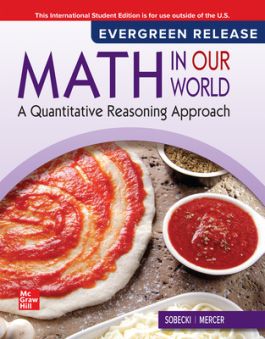
Loose Leaf: Math in Our World: A Quantitative Reasoning Approach: 2026 Release ISE
1265881812
·
9781265881818
Math in Our World: A Quantitative Reasoning Approachexercises students’ brains by challenging them to LEARN, notmemorize formulas or mimic procedures. Students will practicereasoning skills and study situations where mathematicalthinking can help t…
Read More
Receive via shipping:
- Colour, print bound version of the complete text
Unit 1. Mathematical Reasoning and Problem Solving
Lesson 1-1: Inductive and Deductive ReasoningLesson 1-2: Estimation and Interpreting GraphsLesson 1-3: Problem-Solving Strategies
Unit 2. Consumer MathLesson 2-1: Review of Percents
Lesson 2-2: BudgetingLesson 2-3: Simple Interest
Lesson 2-4: Compound Interest
Lesson 2-5: Installment Buying
Lesson 2-6: Education and Home Loans
Lesson 2-7: Stocks and BondsLesson
2-8: Income Taxes
Unit 3. Probability
Lesson 3-1: Basic Probability
Lesson 3-2: Sample Spaces and Counting Techniques
Lesson 3-3: Combinatorics
Lesson 3-4: Probability Using Counting Techniques
Lesson 3-5: Odds and Expected Value
Lesson 3-6: Addition Rules for ProbabilityLesson 3-7: Multiplication Rules and Conditional Probability
Lesson 3-8: Binomial Probabilities
Unit 4. Statistics
Lesson 4-1: Gathering and Organizing DataLesson 4-2: Representing Data Graphically
Lesson 4-3: Measures of Average
Lesson 4-4: Measures of Variation
Lesson 4-5: Measures of Position in a Data Set
Lesson 4-6: Normal Distributions and Z Scores
Lesson 4-7: Applications of the Normal Distribution
Lesson 4-8: Correlation and Regression AnalysisLesson 4-9: Misuses of Statistics
Unit 5. Math ModelingLesson 5-1: Ratios and Proportions
Lesson 5-2: The Basics of Graphing FunctionsLesson 5-3: Modeling with Linear FunctionsLesson 5-4: Modeling with Quadratic FunctionsLesson 5-5: Linear and Quadratic RegressionLesson 5-6: Modeling with Exponential and Log Functions
Unit 6. Set Theory
Lesson 6-1: The Basics of Working with SetsLesson 6-2: Operations on Sets
Lesson 6-3: Studying Sets with Two-Circle Venn Diagrams
Lesson 6-4: Using Sets to Solve Problems
Unit 7. Logic
Lesson 7-1: Statements and Quantifiers
Lesson 7-2: Truth TablesLesson 7-3: Types of Statements in LogicLesson
7-4: Evaluating Logical Arguments
Unit 8. MeasurementLesson 8-1: Unit Conversion, Length, and the Metric System
Lesson 8-2: Measuring Area, Volume, and Capacity
Lesson 8-3: Units of Weight and TemperatureLesson 8-4: Evaluating Efficiency in PackagingUnit 9: Voting Methods (ONLINE ONLY)
Unit 10: Graph Theory (ONLINE ONLY)
Unit 11: Numeration Systems (ONLINE ONLY)
Lesson 1-1: Inductive and Deductive ReasoningLesson 1-2: Estimation and Interpreting GraphsLesson 1-3: Problem-Solving Strategies
Unit 2. Consumer MathLesson 2-1: Review of Percents
Lesson 2-2: BudgetingLesson 2-3: Simple Interest
Lesson 2-4: Compound Interest
Lesson 2-5: Installment Buying
Lesson 2-6: Education and Home Loans
Lesson 2-7: Stocks and BondsLesson
2-8: Income Taxes
Unit 3. Probability
Lesson 3-1: Basic Probability
Lesson 3-2: Sample Spaces and Counting Techniques
Lesson 3-3: Combinatorics
Lesson 3-4: Probability Using Counting Techniques
Lesson 3-5: Odds and Expected Value
Lesson 3-6: Addition Rules for ProbabilityLesson 3-7: Multiplication Rules and Conditional Probability
Lesson 3-8: Binomial Probabilities
Unit 4. Statistics
Lesson 4-1: Gathering and Organizing DataLesson 4-2: Representing Data Graphically
Lesson 4-3: Measures of Average
Lesson 4-4: Measures of Variation
Lesson 4-5: Measures of Position in a Data Set
Lesson 4-6: Normal Distributions and Z Scores
Lesson 4-7: Applications of the Normal Distribution
Lesson 4-8: Correlation and Regression AnalysisLesson 4-9: Misuses of Statistics
Unit 5. Math ModelingLesson 5-1: Ratios and Proportions
Lesson 5-2: The Basics of Graphing FunctionsLesson 5-3: Modeling with Linear FunctionsLesson 5-4: Modeling with Quadratic FunctionsLesson 5-5: Linear and Quadratic RegressionLesson 5-6: Modeling with Exponential and Log Functions
Unit 6. Set Theory
Lesson 6-1: The Basics of Working with SetsLesson 6-2: Operations on Sets
Lesson 6-3: Studying Sets with Two-Circle Venn Diagrams
Lesson 6-4: Using Sets to Solve Problems
Unit 7. Logic
Lesson 7-1: Statements and Quantifiers
Lesson 7-2: Truth TablesLesson 7-3: Types of Statements in LogicLesson
7-4: Evaluating Logical Arguments
Unit 8. MeasurementLesson 8-1: Unit Conversion, Length, and the Metric System
Lesson 8-2: Measuring Area, Volume, and Capacity
Lesson 8-3: Units of Weight and TemperatureLesson 8-4: Evaluating Efficiency in PackagingUnit 9: Voting Methods (ONLINE ONLY)
Unit 10: Graph Theory (ONLINE ONLY)
Unit 11: Numeration Systems (ONLINE ONLY)
Math in Our World: A Quantitative Reasoning Approachexercises students’ brains by challenging them to LEARN, notmemorize formulas or mimic procedures. Students will practicereasoning skills and study situations where mathematicalthinking can help them be smarter and more successful, bothas students and as citizens of society. Math in Our World: AQuantitative Reasoning Approach is comprised of a series ofactivities encouraging students to take responsibility for theirlearning, with strategically placed solved examples and supportto guide them through concepts they may have a hard timediscovering on their own.