Curiosity and the Core of Education: a Trial Looking at Active learning or Traditional Teaching from Thailand
From our ancestors in caves looking to find the best—and safest—foods to eat through to philosophers and truth-seekers looking to better understand metaphysical questions, it’s safe to say that the drive to discover unites mankind. And whilst they say curiosity killed the cat, it’s evident from our history that we are just as curious as our feline friends.
Whilst curiosity stereotypically doesn’t always work so well for cats, for humans a certain amount of inquisitiveness often comes hand-in-hand with a better understanding and enhanced knowledge, and the more we question, the more our knowledge grows and evolves.
It’s curiosity that drives us to find answers to questions. And whilst many questions can be solved through a quick hunt on Google nowadays, there are some questions that need more consideration. Indeed, when the answer is unknown, it’s often the case that experimentation needs to be done to establish the answer and to quell our curiosity. Indeed, those ‘big’ questions seldom have clear answers available.
But with experiments come complications around moral implications. As much as it might be nice to know, for definite, that an idea is true, there is rightly also a need to ensure nobody stands to get hurt in the process.
When it comes to education—undeniably one of the ‘big’ topics mankind devotes much time to exploring—experimentation isn’t something that can be carried out easily because of the negative ramifications of that research. When stakes are high and educational success and attainment are crucial indicators of an individual’s chances of success in life, it would be morally reprehensible to be using education as the foreground for experimentation.
Still, our curiosity means we can’t help but be fascinated by questions at the very core of teaching: what’s the best way to engage students? What’s the best way to deliver our courses? What learning model sees the best results? How can I teach my learners not just the information they need to pass their exams or tests, but also the skills they’ll need later in life?
These were questions that Dr. Vasa Buraphadeja, Associate Professor of Management Information Systems at MSME and his team in Thailand, had been considering. And whilst for many, the idea of giving two groups of learners different tools as part of their course seems morally dubious, Dr Vasa found himself presented by a set of circumstances that meant he could conduct a trial into questions at the very centre of teaching: the question of which learning style affords students the best outcomes.
In Higher Education, there has been much debate around the shift to a hybrid or an active learning model from a more traditional one. The hybrid learning model brings in an emphasis on a blend of activities: some face-to-face teaching, some group-work, some technology. Bonwell (1991) offers a very simple definition of active learning: “In active learning, students participate in the process and students participate when they are doing something beyond passively listening.”[1] The more traditional model sees the transmission of learning being more of a “one-way” approach where a lecturer shares his or her knowledge and the student remembers it.
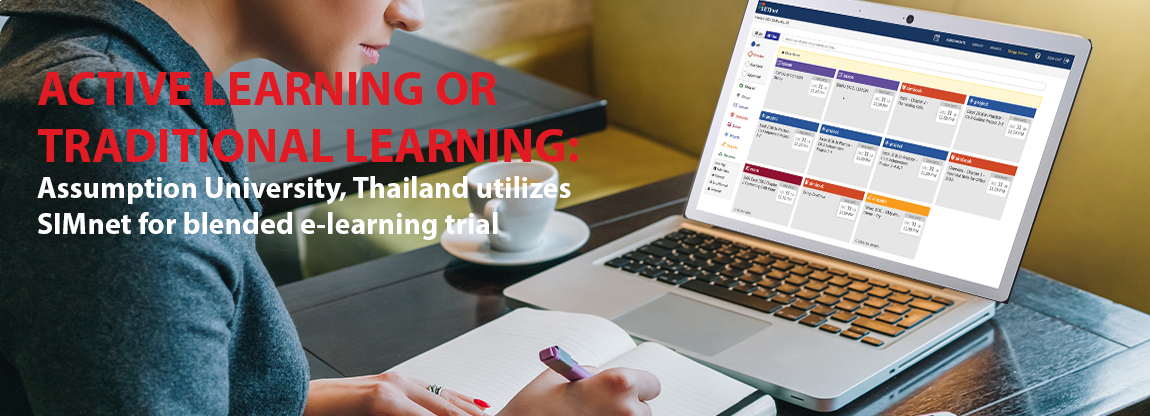
The set-up of Dr Vasa’s course meant he used one method of teaching for one academic year. For the first, he utilized with his group of 150 learners the traditional method of disseminating knowledge. Then, a year later, ensuring his new group had similar levels of competency and skill, he was able to deliver his course using a different model—a model that incorporated group-work and dialogue and one of McGraw Hill’s platforms, SIMnet.
What he found proved important for those in higher education: that the blended learning approach saw his students perform better, across not only their exams but also projects they took as part of their course. On average, those students who were part of the group that was blended and had access to McGraw Hill’s SIMnet, scored 4.68 marks more than their peers who were taught in a traditional manner.
SIMnet provides learning and assessment solutions for Microsoft Office, Windows OS, Computer Concepts, File Management and Internet Browsers which can be integrated with other Learning Management Systems (LMS).
You can read more about the study, the results, and the learnings here.
Have questions or would like a demo on SIMnet, contact our education consultant.
Keen to see how other educators are building great learning experiences and succeeding with McGraw Hill digital solutions, visit this page.
References:
[1] 2. Bonwell, Charles; Eison, James (1991). Active Learning: Creating Excitement in the Classroom. Information Analyses - ERIC Clearinghouse Products (071). pp. 3. ISBN 978-1-878380-08-1. ISSN 0884-0040.